Analysis of the Elite Sports Policy Framework in Iran
DOI:
https://doi.org/10.61838/kman.hn.3.1.2Keywords:
Sports development, elite sports, policy-makingAbstract
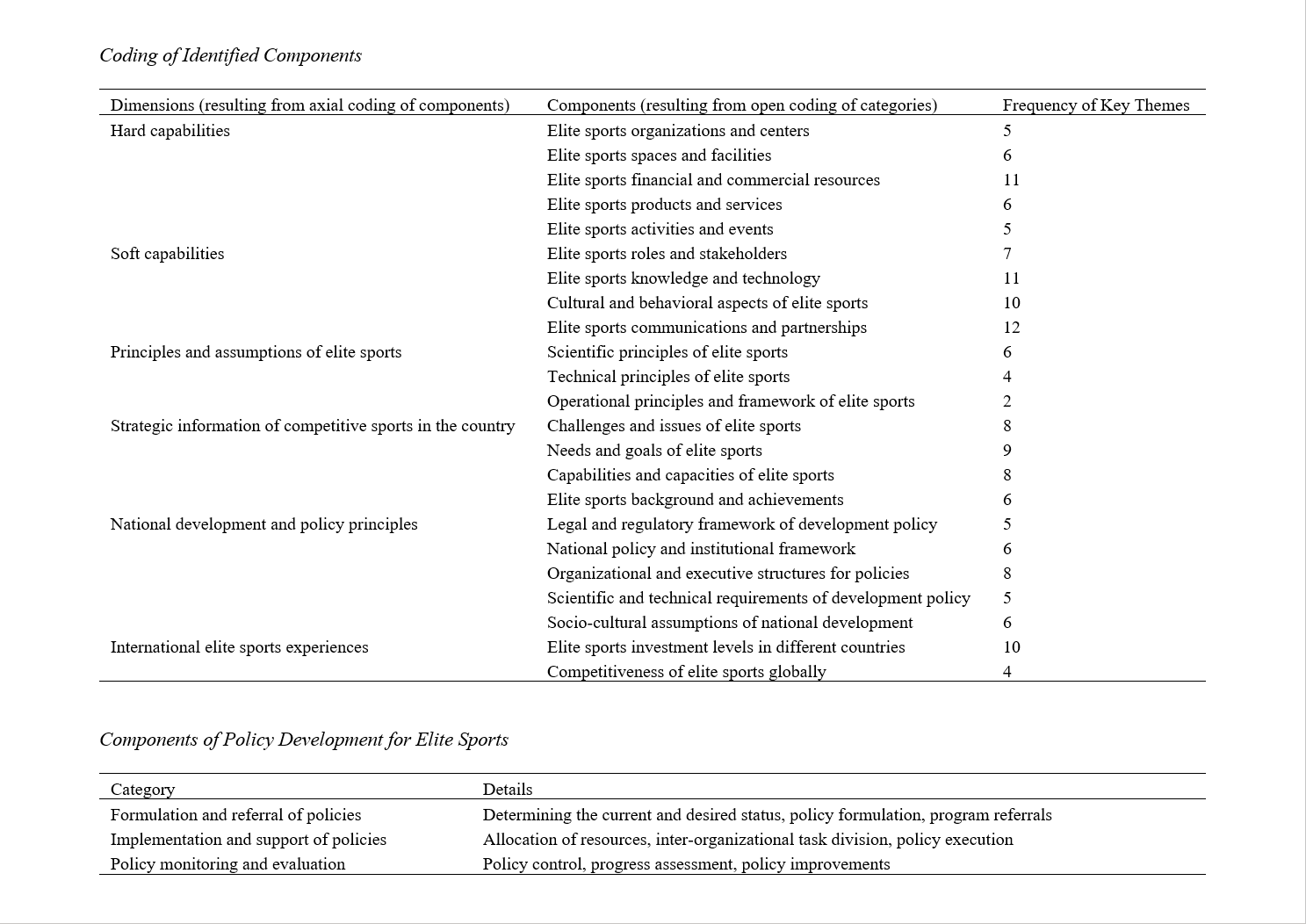
The purpose of the present study was to analyze the policy framework for elite sports in Iran. The research method is qualitative with a systematic analysis approach. The statistical population included all faculty members of physical education, managers, and experts from executive organizations, professional sports organizations, as well as scientific documents and resources. A sufficient sample was selected based on theoretical saturation through purposive and available sampling (16 individuals and 28 documents). Research tools included systematic library study and semi-structured interviews, and the validity of the tools was evaluated using qualitative validity assessment methods (content validity). Data were analyzed using coding and conceptual framework methods. The conceptual framework of elite sports policy in Iran was identified in 10 perspectives and is categorized into 5 conceptual levels: elite sports policy framework, the groundwork for implementing elite sports policies, the policy process for elite sports development, strategic maturity of the elite sports system, and the level of development and functions of elite sports. The framework presented in this research provides an understanding of the dimensions of policy development for elite sports based on its relationship with a set of different activities. Based on this framework, an objective evaluation of management activities in elite sports can be conducted, and scientific information regarding appropriate actions that sports organizations need to take for the development of elite sports policy can be provided.
Downloads
References
1. Urbaneja JS, Cabello-Manrique D, Guevara-Pérez JC, Puga-González E. Understanding the Predictors of Economic Politics on Elite Sport: A Case Study From Spain. International Journal of Environmental Research and Public Health. 2022;19(19):12401. [PMID: 36231701] [PMCID: PMC9566335] [DOI]
2. Naghipour Givi B, Rasaee Rad A. Identifying Effective Factors in the Development of Elite Sports with a Research Synthesis Method: A Meta-synthesis Approach. Sport Management Journal. 2023;15(2):203-18.
3. Pilkington V. Athlete Mental Health and Wellbeing During the Transition Into Elite Sport: Strategies to Prepare the System. Sports Medicine - Open. 2024;10(1). [PMID: 38460048] [PMCID: PMC10924853] [DOI]
4. Mozaffari SA, Aliei A, Abbasi S, Ahadpour H, Rezaei Z. Strategies for the development of the elite sports system in Iran. Journal of Sports Management and Development. 2022;21(57):123-48.
5. De Bosscher V, De Knop P, van Bottenburg M, Shibli S, Bingham J. Explaining international sporting success. An International comparison of elite sport systems and policies in six nations. Sport Management Review. 2009;12:113-36. [DOI]
6. De Bosscher V, Sotiriadou P, van Bottenburg M. Scrutinizing the sport pyramid metaphor: an examination of the relationship between elite success and mass participation in Flanders. International Journal of Sport Policy and Politics. 2013;5(3):319-39. [DOI]
7. Houlihan B, Zheng J. The Olympics and Elite Sport Policy: Where Will It All End? The International Journal of the History of Sport. 2013;30(4):338-55. [DOI]
8. Sotiriadou K. The Sport Development Processes in Australia: University of Technology, Sydney; 2005.
9. Sotiriadou K, Shilbury D. The Attraction, Retention/Transition, and Nurturing Process of Sport Development: Some Australian Evidence. Journal of Sport Management. 2008;22:247-72. [DOI]
10. Sotiriadou K, Shilbury D. Australian elite athlete development: An organizational perspective. Sport Management Review. 2009;13:1-12. [DOI]
11. Ramadhan MG, Paramitha ST, Ma’mun A, Nuryadi N, Juliantine T. Analysis of Elite Sports Development Patterns Through Sports Education. International Journal of Education in Mathematics Science and Technology. 2022;10(4):868-93. [DOI]
12. Tolouei Ashghli A, Pashaei M, Madbari Kaliani R. The Role of Mass Media in the Development of Citizen Sports (Public). Journal of Urban Management Studies. 2010;2(2):193-81.
13. Ramazani Nejad R, Hejberi K. Foundations of Sports Development and Its Application in Iranian Sports. Parliament and Strategy. 2017;24(91):233-63.
14. Karimi J, Soltanian L, Bejani A. Designing the Model of the Development of Adventure Sports Tourism: Grounded Theory. Sport Management Studies. 2020;12(60):61-82. [DOI]
15. Ehsani M, Amiri M, Ghara Khani H. Design and Formulation of a Comprehensive System for Professional Sports in the Country. Sports Management Studies. 2013;17:125-36.
16. Shariati M, Goudarzi M. The Role of Sports Diplomacy in International Relations of the Islamic Republic of Iran: A Qualitative Approach Based on Content Analysis. Biannual Scientific-Research Journal of Political Science. 2015;11(2):95-127.
17. Shabani Bahar G, Erfani N, Goudarzi M, Monsef A. Application of Path Analysis Model in Defining Effective Indicators for the Sports Success of Iranian Teams in International Events. Strategic Studies in Sports and Youth. 2016;15(31):129-46.
18. Rahimi Pardenjani A, Rashidi Nia M, Mirzaei B. The Relationship Between Economic Capital and Development Goals with Sports Success of Free and Greco-Roman Wrestlers of the National Youth Team. Contemporary Research in Sports Management. 2017;7(14):43-52. [DOI]
19. De Bosscher V, De Knop P, van Bottenburg M, Shibli S. A Conceptual Framework for Analysing Sports Policy Factors Leading to International Sporting Success. European Sport Management Quarterly. 2006;6(2):185-215. [DOI]
20. De Bosscher V, De Knop P, van Bottenburg M. Sports, Culture And Society: Why The Netherlands Are Successful In Elite Sports And Belgium Is Not? A Comparison Of Elite Sport Policies. Kinesiologia Slovenica. 2008;14(2):21-40.
21. Funahashi H, De Bosscher V, Mano Y. Understanding public acceptance of elite sport policy in Japan: a structural equation modelling approach. European Sport Management Quarterly. 2015;15(4):478-504. [DOI]
22. Yuon gao R, Robinson L. A Comparison between Talent Identification and Development (TID) for Badminton in China and the UK: Faculty of Health Sciences and Sport; 2017.
23. Bramham P, Hylton K, Jackson D, Nesti M. Sports Development: Policy, Process and Practice. London: Routledge; 2001.
24. Green BC. Building sport programs to optimize athlete recruitment, retention, and transition: Toward a normative theory of sport development. Journal of Sport Management. 2005;19(3):233-53. [DOI]
Downloads
Additional Files
Publication Timeline
- Submitted
- Revised
- Accepted
Issue
Section
License

This work is licensed under a Creative Commons Attribution-NonCommercial 4.0 International License.