Structural Relationships of Attachment Styles with Social Anxiety in Adolescents Dependent on Internet Games: The Mediating Role of Loneliness
DOI:
https://doi.org/10.61838/kman.hn.2.4.1Keywords:
Attachment styles, social anxiety, loneliness, adolescents, internet gamesAbstract
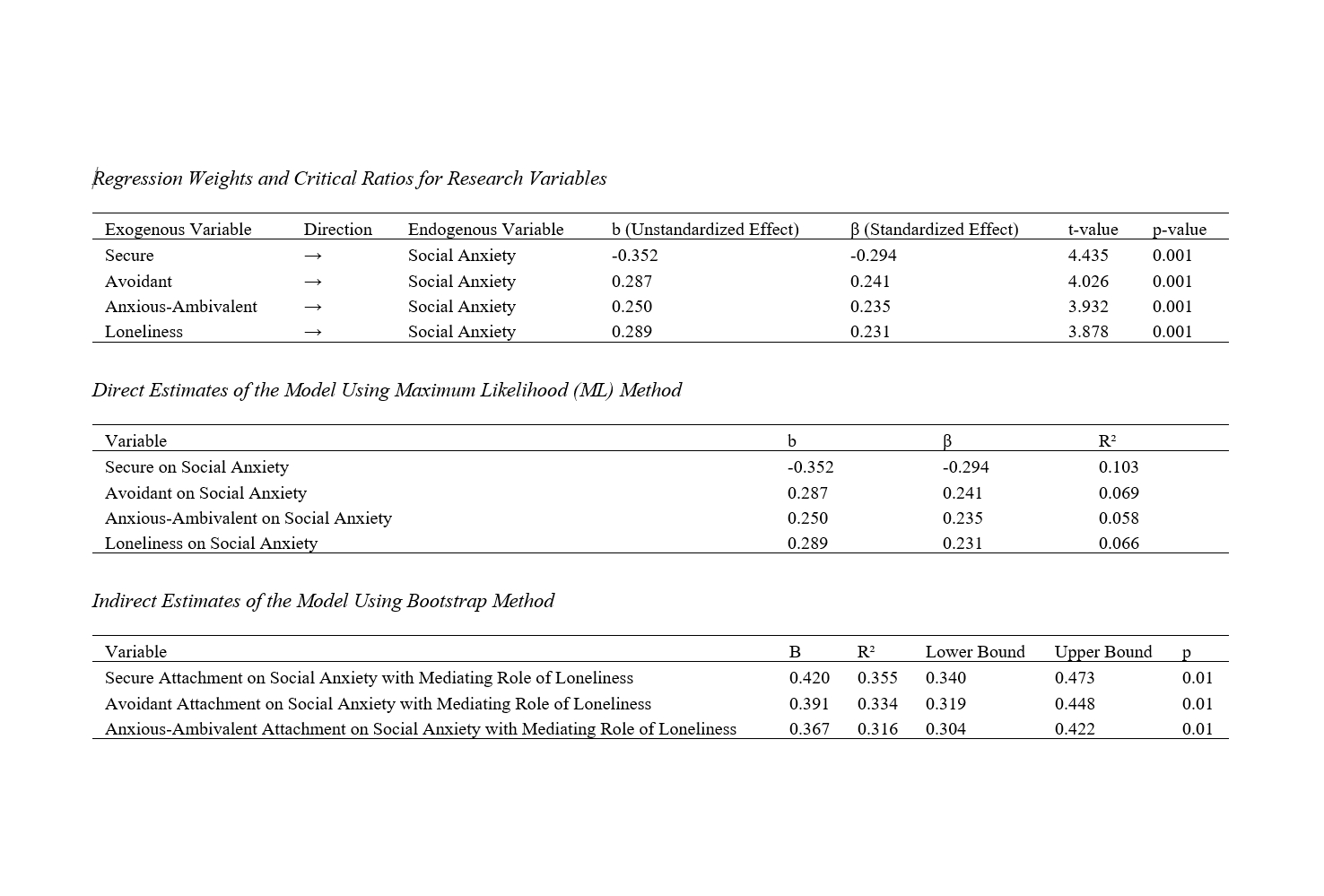
This study aimed to examine the structural relationships between attachment styles and social anxiety in adolescents dependent on internet games, considering the mediating role of loneliness. A random sample of 200 adolescents dependent on internet games was selected, and questionnaires on attachment style, social anxiety, and loneliness were completed for them. The results showed that a secure attachment style directly and indirectly leads to reduced social anxiety through decreased loneliness. Additionally, avoidant and anxious-ambivalent attachment styles directly and indirectly lead to increased social anxiety through heightened loneliness. These findings indicate that loneliness plays a significant mediating role in the relationship between attachment styles and social anxiety in adolescents dependent on internet games.
Downloads
References
1. Yan X, Gao W, Yang J, Yuan J. Emotion Regulation Choice in Internet Addiction: Less Reappraisal, Lower Frontal Alpha Asymmetry. Clinical EEG and Neuroscience. 2022;53(4):278-86. [PMID: 34894803] [DOI]
2. Yang M, Sheng X, Ge M, Zhang L, Huang C, Cui S, et al. Childhood Trauma and Psychological Sub-Health Among Chinese Adolescents: The Mediating Effect of Internet Addiction. BMC Psychiatry. 2022. [DOI]
3. Yang X, Zhu L, Chen Q, Song P, Wang Z. Parent marital conflict and Internet addiction among Chinese college students: The mediating role of father-child, mother-child, and peer attachment. Computers in Human Behavior. 2016;59:221-9. [DOI]
4. Bozorgkhoo z, Safari A, Mortezabeigi z, AsGharnejad Farid A. Comparing self-efficacy, quality of life and sleep quality among medical students with and without internet addiction. Payesh (Health Monitor) Journal. 2022;21(2):197-205. [DOI]
5. Pourmohseni K, Fereshteh, Farshi G. Comparing Cognitive Impairment, Borderline Personality Symptoms and Impulsivity in Internet-Addicted and Non-Addicted Students. Advances in Cognitive Science. 2019;20(4):70.
6. Tras Z. Internet Addiction and Loneliness as Predictors of Internet Gaming Disorder in Adolescents. Educational Research and Reviews. 2019;14(13):465-73. [DOI]
7. Soh PC-H, Chew KW, Koay KY, Ang PH. Parents vs peers’ influence on teenagers’ Internet addiction and risky online activities. Telematics and Informatics. 2018;35(1):225-36. [DOI]
8. Zhu J, Zhang W, Yu C, Bao Z. Early adolescent Internet game addiction in context: How parents, school, and peers impact youth. Computers in Human Behavior. 2015;50:159-68. [DOI]
9. Skues J, Williams B, Oldmeadow J, Wise L. The Effects of Boredom, Loneliness, and Distress Tolerance on Problem Internet Use Among University Students. International Journal of Mental Health and Addiction. 2016;14(2):167-80. [DOI]
10. Wu X-S, Zhang Z-H, Zhao F, Wang W-J, Li Y-F, Bi L, et al. Prevalence of Internet addiction and its association with social support and other related factors among adolescents in China. Journal of Adolescence. 2016;52(1):103-11. [PMID: 27544491] [DOI]
11. Brand M, Laier C, Young KS. Internet addiction: coping styles, expectancies, and treatment implications. Frontiers in Psychology. 2014;5. [PMID: 25426088] [PMCID: PMC4227484] [DOI]
12. Chen H-C, Wang J-Y, Lin Y-L, Yang S-Y. Association of Internet Addiction with Family Functionality, Depression, Self-Efficacy and Self-Esteem among Early Adolescents. International Journal of Environmental Research and Public Health [Internet]. 2020 PMC7731192]; 17(23).
13. Masaeli N, Farhadi H. Internet Addiction and Depression in Iran: Investigating the Mediating Roles of Loneliness and Disordered Sleep and Moderating Role of Gender. International Journal for the Advancement of Counselling. 2021;43(4):407-23. [DOI]
14. Saikia AM, Das J, Barman P, Bharali MD. Internet Addiction and its Relationships with Depression, Anxiety, and Stress in Urban Adolescents of Kamrup District, Assam. Journal of Family and Community Medicine. 2019;26(2):108-12. [PMID: 31143082] [PMCID: PMC6515762] [DOI]
15. Servidio R, Bartolo MG, Palermiti AL, Costabile A. Fear of COVID-19, depression, anxiety, and their association with Internet addiction disorder in a sample of Italian students. Journal of Affective Disorders Reports. 2021;4:100097. [DOI]
16. Liu C, Rotaru K, Chamberlain SR, Liu R, Fontenelle LF, Lee RS, et al. The Moderating Role of Psychological Flexibility on the Association Between Distress-Driven Impulsivity and Problematic Internet Use. International Journal of Environmental Research and Public Health. 2022. [DOI]
17. Elhai JD, Levine JC, Dvorak RD, Hall BJ. Fear of missing out, need for touch, anxiety and depression are related to problematic smartphone use. Computers in Human Behavior. 2016;63:509-16. [DOI]
18. Qudsi F, Asadzadeh H. Prediction of the general health of Internet user students based on the dependence on the Internet (Case Study: Tehran and Baku). Iranian Journal of Educational Sociology. 2017;1(4):34-47.
19. Hadadian F, Tehranizadeh M, Pakdel M. The Roles of Family, Emotion Regulation Strategies, and Mental Health in the Problematic Internet Use. Journal of adolescent and youth psychological studies. 2020;1(1):317-27.
20. Jaiswal A, Manchanda S, Gautam V, Goel AD, Aneja J, Raghav PR. Burden of internet addiction, social anxiety and social phobia among University students, India. Journal of Family Medicine and Primary Care. 2020;9(7). [PMID: 33102337] [PMCID: PMC7567262] [DOI]
21. Lyvers M, Salviani A, Costan S, Thorberg FA. Alexithymia, Narcissism and Social Anxiety in Relation to Social Media and Internet Addiction Symptoms. International Journal of Psychology. 2022. [PMID: 35262189] [DOI]
22. Ko CH, Yen JY, Yen CF, Chen CS, Chen CC. The association between Internet addiction and psychiatric disorder: A review of the literature. European Psychiatry. 2012;27(1):1-8. [PMID: 22153731] [DOI]
23. Kumar M, Mondal A. A study on Internet addiction and its relation to psychopathology and self-esteem among college students. Industrial Psychiatry Journal. 2018;27(1):61-6. [PMID: 30416293] [PMCID: PMC6198588] [DOI]
24. Wolniewicz CA, Tiamiyu MF, Weeks JW, Elhai JD. Problematic smartphone use and relations with negative affect, fear of missing out, and fear of negative and positive evaluation. Psychiatry Research. 2018;262:618-23. [PMID: 28982630] [DOI]
25. Alavi SS, Marathi MR, Janatifard F, Islami M, Haghighi M. A Survey of Relationship between Psychiatric Symptoms and Internet Addiction in Students of Isfahan Universities. Avicenna Journal of Clinical Medicine. 2010;17(2):57.
26. Whang LS-M, Lee S, Chang G. Internet Over-Users' Psychological Profiles: A Behavior Sampling Analysis on Internet Addiction. CyberPsychology & Behavior. 2003;6(2):143-50. [PMID: 12804026] [DOI]
27. Dong WL, Li YY, Zhang YM, Peng QW, Lu GL, Chen CR. Influence of childhood trauma on adolescent internet addiction: The mediating roles of loneliness and negative coping styles. World J Psychiatry. 2023;13(12):1133-44. [PMID: 38186732] [PMCID: PMC10768484] [DOI]
28. Ledur B, Schmitt M, Luana Thereza Nesi de M, Andretta I. Relationship Between Internet Addiction and Feelings of Loneliness in University Students From a Private Institution Southern Brazil. Psique. 2022;18(1). [DOI]
29. Ahmadi M, Nikomanesh Z, Farnam A. Effectiveness of Stress-Based Mindfulness Therapy on the Students' Feelings of Loneliness and Internet Addiction. umsha-psj. 2021;19(4):1-9. [DOI]
30. Lee J-Y, Ko DW, Hyemin L. Loneliness, Regulatory Focus, Inter-Personal Competence, and Online Game Addiction. Internet Research. 2019;29(2):381-94. [DOI]
31. Karaer Y, Akdemir D. Parenting styles, perceived social support and emotion regulation in adolescents with internet addiction. Comprehensive Psychiatry. 2019;92:22-7. [PMID: 31003724] [DOI]
32. Zhang W, Pu J, He R, Yu M, Xu L, He X, et al. Demographic characteristics, family environment and psychosocial factors affecting internet addiction in Chinese adolescents. Journal of Affective Disorders. 2022;315:130-8. [PMID: 35901990] [DOI]
33. Nakhoul L, Obeid S, Sacre H, Haddad C, Soufia M, Hallit R, et al. Attachment style and addictions (alcohol, cigarette, waterpipe and internet) among Lebanese adolescents: a national study. BMC Psychology. 2020;8(1):33. [PMID: 32299500] [PMCID: PMC7164203] [DOI]
34. Soleymani S, Mohammadkhani P, Zahrakar K. Developing a model of symptoms of nomophobia in students based on attachment style, media literacy and locus of control with the mediation of Internet addiction. Journal of Adolescent and Youth Psychological Studies (JAYPS). 2023;4(3):83-96. [DOI]
35. Sung Y, Nam T-H, Hwang MH. Attachment style, stressful events, and Internet gaming addiction in Korean university students. Personality and Individual Differences. 2020;154:109724. [DOI]
Downloads
Additional Files
Publication Timeline
License
Copyright (c) 2024 Roya Norouzian (Author); Arsalan Khanmohammadi (Corresponding Author); Ali Khanehkeshi (Author)

This work is licensed under a Creative Commons Attribution-NonCommercial 4.0 International License.