Comparison of Sexual Self-Efficacy, 5-Hydroxyindoleacetic Acid Levels, and White Blood Cell Counts in Women with Orgasmic Disorder and Healthy Controls
DOI:
https://doi.org/10.61838/kman.hn.2.3.1Keywords:
Sexual self-efficacy, 5-hydroxyindoleacetic acid, , white blood cell count, orgasmic disorder in womenAbstract
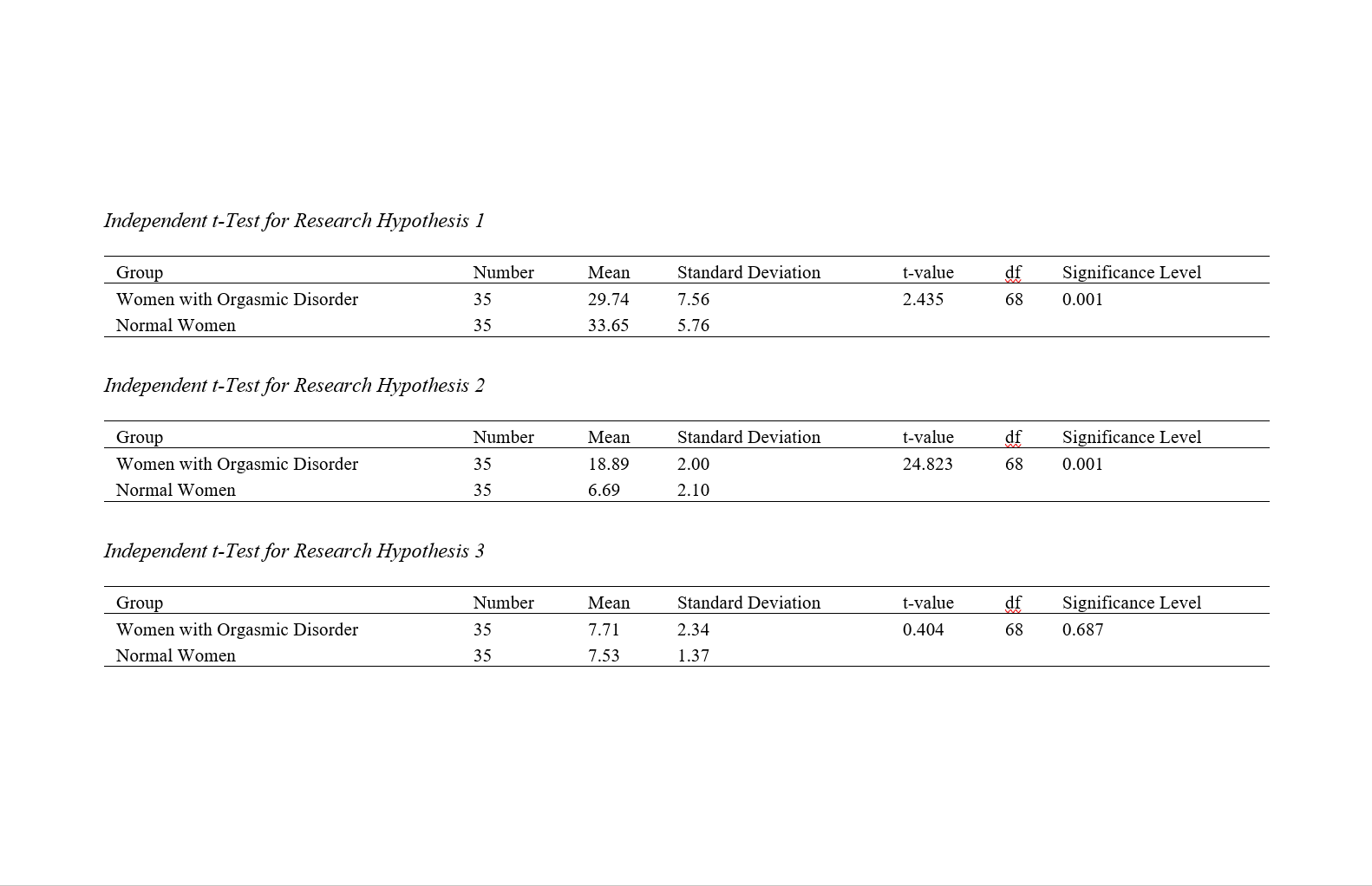
The present study aimed to compare sexual self-efficacy, 5-hydroxyindoleacetic acid levels, and white blood cell (WBC) counts in women with orgasmic disorder versus healthy controls. The research method was causal-comparative, and the population included all women diagnosed with orgasmic disorder in Shiraz during 2018. A convenience sampling method was used; thus, based on the research objectives, samples were taken from 35 women with orgasmic disorder and 35 women without such disorder, matched by age and educational level. WBC levels were measured using a complete blood count (CBC) test, and 5-hydroxyindoleacetic acid levels were determined by colorimetric methods and high-performance liquid chromatography (HPLC). Questionnaires were analyzed using SPSS version 20 software through descriptive and inferential statistics. The data were examined using the t-test. Results showed that there were significant differences in sexual self-efficacy between women with orgasmic disorder and healthy controls, with the former group exhibiting lower sexual self-efficacy. There were also significant differences in 5-hydroxyindoleacetic acid levels between the two groups, with higher levels observed in women with orgasmic disorder. However, no significant differences were found in WBC counts between the two groups.
Downloads
References
1. Monteiro Pascoal P, Cardoso D, Henriques R. Sexual Satisfaction and Distress in Sexual Functioning in a Sample of the BDSM Community: A Comparison Study Between BDSM and Non-BDSM Contexts. The Journal of Sexual Medicine. 2015;12(4):1052-61. [PMID: 25689233] [DOI]
2. Rafii S, Jamhari F. The relationship between marital infidelity and lovemaking styles with couples' sexual satisfaction with each other. Sociology of Education. 2018;4(1):158-70.
3. American Psychiatric Association A. Diagnostic and statistical manual of mental disorders: DSM-5-TR: Washington, DC: American psychiatric association; 2022. [DOI]
4. Frohlich PF, Meston CM. Evidence that serotonin affects female sexual functioning via peripheral mechanisms. Physiology & Behavior. 2000;71(3):383-93. [PMID: 11150571] [DOI]
5. Wu H, Denna TH, Storkersen JN, Gerriets VA. Beyond a neurotransmitter: The role of serotonin in inflammation and immunity. Pharmacological Research. 2019;140:100-14. [PMID: 29953943] [DOI]
6. Nur’aini, Afiyanti Y, Setyowati. Sexual self-efficacy: Affection, sexual communication, and self-acceptance as significant factors related to sexual function on menopausal women in Indonesia. Enfermería Clínica. 2019;29:551-5. [DOI]
7. Zare Z, Golmakani N, Shareh H, Shakeri MT. Survey of Relationship between Sexual Self-efficacy and Sexual Life Quality with Marital Satisfaction in Primiparous Women after Childbirth. Beyhagh. 2016;21(2):1-10.
8. McKenzie N. Female Sexual Interest and Arousal Disorder: How We Can Help When Our Patient’s Libido Hits the Brakes. Physician Assistant Clinics. 2018;3(3):385-97. [DOI]
9. Shahram V, Farah Lotfi K. Study of factor structure, reliability and validity of the sexual self efficacy questionnaire. Thought and Behavior in Clinical Psychology. 2013;8(29):47-56.
10. Ramezani N, Dolatian M, Shams J, Alavi H. The relationship between self-esteem and sexual dysfunction and satisfaction in women. Journal of Arak University of Medical Sciences. 2012;14(6):57-65.
11. Salmani Z, Tadayon M, Alavifazel K. Prevalence and etiology of orgasm disorders in women. J Kermanshah Univ Med Sci. 2010;14(1):e79545.
12. Raziyeh Taghani, Akram Ashrafizaveh, Mahsa Ghanbari Soodkhori , Elham Azmoude, Maryam Tatari. Marital satisfaction and its associated factors at reproductive age women referred to health centers. Journal of Education and Health Promotion. 2019;9(7):1-5. [PMID: 31463318] [PMCID: PMC6691613] [DOI]
13. Angele MK, Schwacha MG, Ayala A, Chaudry IH. EFFECT OF GENDER AND SEX HORMONES ON IMMUNE RESPONSES FOLLOWING SHOCK. Shock. 2000;14(2):81-90. [PMID: 10947147] [DOI]
Downloads
Additional Files
Publication Timeline
License
Copyright (c) 2024 Ilnaz Zarghami (Author); Masoud Mohammadi (Corresponding Author)

This work is licensed under a Creative Commons Attribution-NonCommercial 4.0 International License.