The Relationship Between Brain-Behavior Systems, Dark Personality Traits, Alexithymia, and Theory of Mind Deficits in Sexual Offenders
DOI:
https://doi.org/10.61838/kman.hn.2.2.13Keywords:
Brain-behavior systems, dark personality dimensions, Alexithymia, theory of mind, sexual offendersAbstract
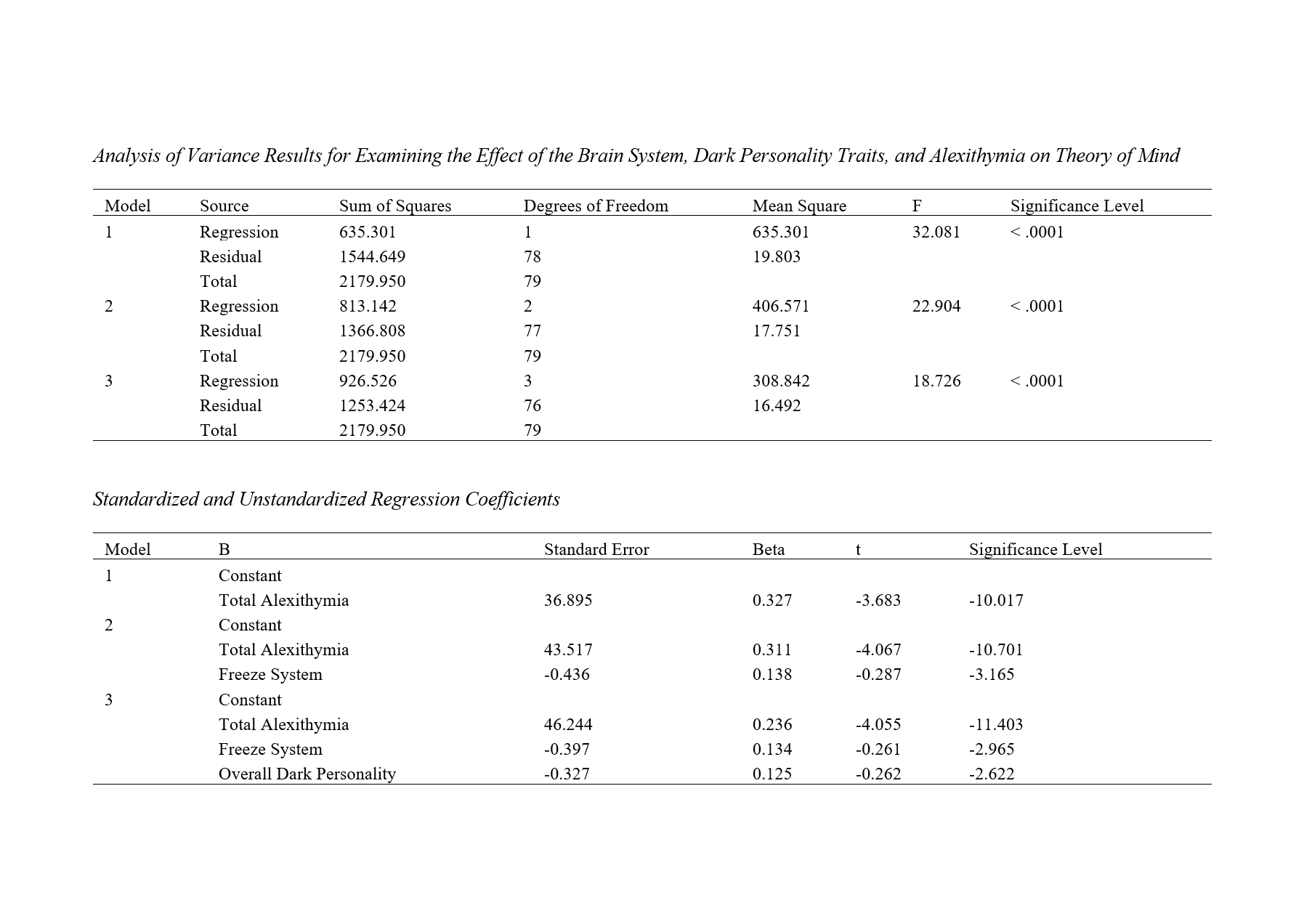
The aim of the current research is to examine the relationship between brain-behavior systems, dark personality dimensions, and Alexithymia with theory of mind deficits in sexual offenders. For this purpose, 80 inmates from the central prison of Bojnurd were selected using purposive sampling. The variables were measured using the Gray-Wilson Personality Questionnaire (GWPQ), the Dirty Dozen scale of dark personality traits, the 20-item Toronto Alexithymia Scale (TAS-20), and the Reading the Mind in the Eyes Test (RMET). Data were analyzed using Pearson correlation coefficients and multiple regression analysis. The results showed a significant positive correlation between the fight system and theory of mind deficits; and significant negative correlations between the flight and freeze systems, all aspects of dark personality dimensions, difficulty in identifying and describing feelings, and overall Alexithymia with theory of mind deficits. The regression analysis findings suggest that the fight/flight/freeze systems, dark personality traits, and Alexithymia play predictive roles in mind-reading abilities.
Downloads
References
1. American Psychiatric Association A. Diagnostic and statistical manual of mental disorders: DSM-5-TR: Washington, DC: American psychiatric association; 2022. [DOI]
2. Maruna S, Mann, Ruth E. A fundamental attribution error? Rethinking cognitive distortions†. Legal and Criminological Psychology. 2006;11(2):155-77. [DOI]
3. Yates PM. Treatment of sexual offenders: Research, best practices, and emerging models. International journal of behavioral consultation and therapy. 2013;8(3-4):89. [DOI]
4. Castellino N, Bosco, Francesca M, Marshall, William L, Marshall, Liam E, Veglia, Fabio. Mindreading abilities in sexual offenders: An analysis of theory of mind processes. Consciousness and Cognition. 2011;20(4):1612-24. [PMID: 21924641] [DOI]
5. O’Grady AM, Nag S. “Where’s Wally?” Identifying Theory of Mind in School-Based Social Skills Interventions. Frontiers in Psychology. 2022;13. [PMID: 36389472] [PMCID: PMC9646489] [DOI]
6. Miri SS, Zahiri H. Investigating the Relationship Between Coping Styles, Alexithymia, and Management Styles with Job Satisfaction (Case Study: The Employees of the Maad Group). Journal of Assessment and Research in Applied Counseling (JARAC). 2024;6(2):1-10. [DOI]
7. Smith ER, Semin, Gün R. Situated Social Cognition. Current Directions in Psychological Science. 2007;16(3):132-5. [DOI]
8. Mahdavi M, Mehrinejad SA, Karami A, Roshan Chesli R. The Mediating Role of Dark Personality Traits in Explaining the Structural Relationships Between the Desire to Control Others and Women's Sense of Happiness. Applied Family Therapy Journal (AFTJ). 2024;5(2):79-86. [DOI]
9. Turan ME, Adam, Firdevs, Kaya, Alican, Yıldırım, Murat. The mediating role of the dark personality triad in the relationship between ostracism and social media addiction in adolescents. Education and Information Technologies. 2024;29(4):3885-901. [DOI]
10. Ghasemzadeh R, Mahmoudalilou M, Bakhshipour Roudsari A, Bayrami M. The Relationship between brain-behavioral systems and cluster B personality disorders by mediating dark traits of personality. Journal of Adolescent and Youth Psychological Studies (JAYPS). 2023;4(5):158-68. [DOI]
11. Ináncsi T, Láng A, Bereczkei T. A Darker Shade of Love: Machiavellianism and Positive Assortative Mating Based on Romantic Ideals. Europe’s Journal of Psychology. 2016;12(1):137-52. [PMID: 27247697] [PMCID: PMC4873071] [DOI]
12. Borgholthaus CJ, White, Joshua V, Harms, Peter D. CEO dark personality: A critical review, bibliometric analysis, and research agenda. Personality and Individual Differences. 2023;201(no):111951. [DOI]
13. Peixoto Â, Gouveia, T, Sousa, P, Faria, R, Almeida, P. R. Dark personality traits and tolerance towards unethical behaviors on entrepreneurship: A comparison between entrepreneurs and non-entrepreneurs. Journal of White Collar and Corporate Crime. 2023;4(1):5-13. [DOI]
14. Sadeghkhani M, Emamipour S, Mirhashemi M. The structural model of emotional divorce based on the dark triad traits of personality and conflict resolution styles with the mediation of marital dissatisfaction. Journal of Applied Family Therapy. 2023;4(2):444-71. [DOI]
15. Sanatjou S, Bakhshipour Roudsari A, Hashemi Nosrat Abad T, Mahmoudalilou M. Structural Relationships between brain- behavior systems and Cloninger Temperament and Character model with Tetrad dark sides of personality. Journal of Adolescent and Youth Psychological Studies (JAYPS). 2023;4(9):79-88. [DOI]
16. Baron-Cohen S, Wheelwright, Sally, Hill, Jacqueline, Raste, Yogini, Plumb, Ian. The “Reading the Mind in the Eyes” Test Revised Version: A Study with Normal Adults, and Adults with Asperger Syndrome or High-functioning Autism. The Journal of Child Psychology and Psychiatry and Allied Disciplines. 2001;42(2):241-51. [PMID: 11280420] [DOI]
17. Haghighati F, Pak R, Bafandeh H. Comparing the executive function and cognitive flexibility and theory of mind in foster and non-foster children. Rooyesh-e-Ravanshenasi Journal(RRJ). 2019;8(3):29-36.
18. Roshandel Z, Ghaffari A, Kazemi R, Nadermohammadi M. Effectiveness of Acceptance and Commitment based Therapy on Pain Severity, Fatigue, and Alexithymia in Female Patients with Rheumatic Diseases. Applied Family Therapy Journal (AFTJ). 2022;3(5):84-100. [DOI]
19. Jordan KD, Smith, Timothy W. The interpersonal domain of alexithymia. Personality and Individual Differences. 2017;110(no):65-9. [DOI]
20. Lane RD, su, Chiu-Hsieh, Locke, Dona E. C, Ritenbaugh, Cheryl, Stonnington, Cynthia M. Role of theory of mind in emotional awareness and alexithymia: Implications for conceptualization and measurement. Consciousness and Cognition. 2015;33(no):398-405. [PMID: 25766906] [DOI]
21. Taylor GJ. Recent Developments in Alexithymia Theory and Research. The Canadian Journal of Psychiatry. 2000;45(2):134-42. [PMID: 10742872] [DOI]
22. Besharat MA. The relations between personality dimensions and alexithymia. contemporary psychology. 2007;2(2):55-66.
23. Henry JD, Phillips, Louise H, Maylor, Elizabeth A, Hosie, Judith, Milne, Alan B, Meyer, Caroline. A new conceptualization of alexithymia in the general adult population: implications for research involving older adults. Journal of Psychosomatic Research. 2006;60(5):535-43. [PMID: 16650595] [DOI]
24. Lackner CL, owman, Lindsay C, Sabbagh, Mark A. Dopaminergic functioning and preschoolers’ theory of mind. Neuropsychologia. 2010;48(6):1767-74. [PMID: 20206642] [DOI]
Downloads
Additional Files
Publication Timeline
License
Copyright (c) 2024 Seyed Hossein Alavi (Author); Majid Mahmoud Alilou (Corresponding Author); Zeynab Khanjani (Author)

This work is licensed under a Creative Commons Attribution-NonCommercial 4.0 International License.