Brief Review: Virtual Reality and Physical Exercise as Countermeasures of Coping the Space Missions
DOI:
https://doi.org/10.61838/kman.hn.2.2.4Keywords:
Virtual reality, Physical exercise, Microgravity, Physical rehabilitation, Space scienceAbstract
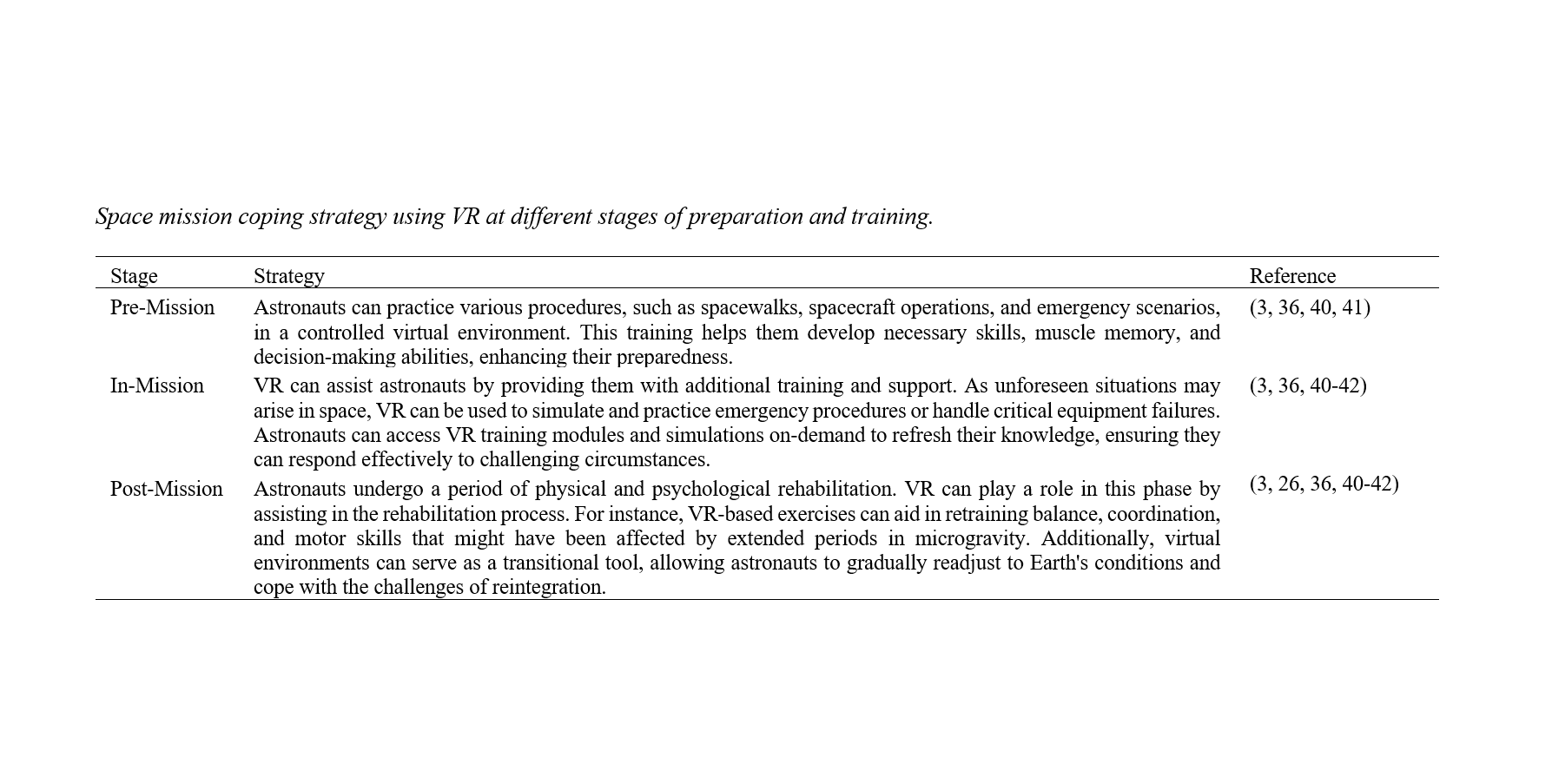
Microgravity is an environment incompatible with human physiology that induces unique physiological changes to the body. Exposure to microgravity environment can cause some possible physiological hazards, such as impairment of immune function, bone mass and skeletal muscle mass, in addition to possible negative psycological alterations (depression, anxiety, apathy, and personality changes). These pysico-physiological changes negatively impact health status and quality of life and result in operational difficulties on a space mission for the astronauts. Countermeasures designed to lessen the effect of microgravity on the human body include daily physical exercise and rehabilitation, psychotherapy, specific diets, pharmaceutical treatments, and the use of technologies. Virtual reality (VR) added to physical exercise programs, in the training and preparation of the astronauts for the space missions, could have more exuberant effects. Therefore, the aim of this perspective article is to present the application of VR and physical exercise as countermeasures for training and preparation before, during and after a space missions.
Downloads
References
1. Kandarpa K, Schneider V, Ganapathy K. Human health during space travel: An overview. Neurology India. 2019;67(Suppl 2). [PMID: 31134907] [DOI]
2. Pavez Loriè E, Baatout S, Choukér A, Buchheim J-I, Baselet B, Dello Russo C, et al. The Future of Personalized Medicine in Space: From Observations to Countermeasures. Frontiers in Bioengineering and Biotechnology. 2021;9. [PMID: 34966726 ] [PMCID: PMC8710508] [DOI]
3. Ebnali M, Paladugu P, Miccile C, Park SH, Burian B, Yule S, Dias RD. Extended Reality Applications for Space Health. Aerospace Medicine and Human Performance. 2023;94(3):122-30. [PMID: 36829279] [DOI]
4. NASA. Bone and Muscle Loss in Microgravity 2020 [Available from: https://www.nasa.gov/mission_pages/station/research/station-science-101/bone-muscle-loss-in-microgravity/#:~:text=In.
5. Juhl OJ, Buettmann EG, Friedman MA, DeNapoli RC, Hoppock GA, Donahue HJ. Update on the effects of microgravity on the musculoskeletal system. npj Microgravity. 2021;7(1):28. [PMID: 34301942] [PMCID: PMC8302614] [DOI]
6. Sartori R, Romanello V, Sandri M. Mechanisms of muscle atrophy and hypertrophy: implications in health and disease. Nature Communications. 2021;12(1):330. [PMID: 33436614] [PMCID: PMC7803748] [DOI]
7. Swaffield TP, Neviaser AS, Lehnhardt K. Fracture Risk in Spaceflight and Potential Treatment Options. Aerospace Medicine and Human Performance. 2018;89(12):1060-7. [PMID: 30487026] [DOI]
8. Benedetti MG, Furlini G, Zati A, Letizia Mauro G. The Effectiveness of Physical Exercise on Bone Density in Osteoporotic Patients. BioMed Research International. 2018;2018:4840531. [PMID: 30671455] [PMCID: PMC6323511] [DOI]
9. Flanagan AM, Chambers TJ. Inhibition of bone resorption by bisphosphonates: Interactions between bisphosphonates, osteoclasts, and bone. Calcified Tissue International. 1991;49(6):407-15. [PMID: 1840176] [DOI]
10. O’Conor DK, Dalal S, Ramachandran V, Shivers B, Shender BS, Jones JA. Crew-Friendly Countermeasures Against Musculoskeletal Injuries in Aviation and Spaceflight. Frontiers in Physiology. 2020;11. [PMID: 32754055] [PMCID: PMC7367058] [DOI]
11. Petersen N, Jaekel P, Rosenberger A, Weber T, Scott J, Castrucci F, et al. Exercise in space: the European Space Agency approach to in-flight exercise countermeasures for long-duration missions on ISS. Extreme Physiology & Medicine. 2016;5(1):9. [PMID: 27489615] [PMCID: PMC4971634] [DOI]
12. Marzetti E, Calvani R, Tosato M, Cesari M, Di Bari M, Cherubini A, et al. Physical activity and exercise as countermeasures to physical frailty and sarcopenia. Aging Clinical and Experimental Research. 2017;29(1):35-42. [PMID: 28181204] [DOI]
13. Finseth T, Dorneich MC, Keren N, Franke WD, Vardeman S. Virtual Reality Adaptive Training for Personalized Stress Inoculation. Human Factors. 2024;0(0):00187208241241968. [PMID: 38546259] [DOI]
14. Erickson NOK. Nasa Science: Space place - Explore Earth and Space. 2020.
15. Yamashita M, Baba SA. Biology of Size and Gravity. Biological Sciences in Space. 2004;18(1):13-27. [PMID: 15173628] [DOI]
16. Knows N. What Is Microgravity? 2017.
17. English KL, Downs M, Goetchius E, Buxton R, Ryder JW, Ploutz-Snyder R, et al. High intensity training during spaceflight: results from the NASA Sprint Study. npj Microgravity. 2020;6(1):21. [PMID: 32864428] [PMCID: PMC7434884] [DOI]
18. Nasa.gov. ARED – RESISTIVE EXERCISE IN SPACE.
19. Research IBM. Augmented and Virtual Reality Research at IBM Watson. 2020.
20. Nekar DM, Kang HY, Yu JH. Improvements of Physical Activity Performance and Motivation in Adult Men through Augmented Reality Approach: A Randomized Controlled Trial. Journal of Environmental and Public Health. 2022;2022:1-11. [PMID: 35855818] [PMCID: PMC9288278] [DOI]
21. Kyaw BM, Saxena N, Posadzki P, Vseteckova J, Nikolaou CK, George PP, et al. Virtual Reality for Health Professions Education: Systematic Review and Meta-Analysis by the Digital Health Education Collaboration. Journal of Medical Internet Research. 2019;21(1):e12959. [PMID: 30668519] [PMCID: PMC6362387] [DOI]
22. Microsoft. What is augmented reality or AR?
23. Immersive Virtual Reality. Encyclopedia of Multimedia. Boston, MA2008. p. 345-6. [DOI]
24. Qian J, McDonough DJ, Gao Z. The Effectiveness of Virtual Reality Exercise on Individual’s Physiological, Psychological and Rehabilitative Outcomes: A Systematic Review. International Journal of Environmental Research and Public Health. 2020;17(11):4133. [PMID: 32531906] [PMCID: PMC7312871] [DOI]
25. Hodkinson PD, Anderton RA, Posselt BN, Fong KJ. An overview of space medicine. British Journal of Anaesthesia. 2017;119:i143-i53. [PMID: 29161391] [DOI]
26. Salamon N, Grimm JM, Horack JM, Newton EK. Application of virtual reality for crew mental health in extended-duration space missions. Acta Astronautica. 2018;146:117-22. [DOI]
27. Bhugaonkar K, Bhugaonkar R, Masne N. The trend of metaverse and augmented & virtual reality extending to the healthcare system. Cureus. 2022;14(9). [DOI]
28. Mulavara AP, Peters BT, Miller CA, Kofman IS, Reschke MF, Taylor LC, et al. Physiological and Functional Alterations after Spaceflight and Bed Rest. Medicine & Science in Sports & Exercise. 2018;50(9). [PMID: 29620686] [PMCID: PMC6133205] [DOI]
29. EP E. Deconditioning 2022 [Available from: https://elsevier.health/en-US/preview/deconditioning.
30. Demontis GC, Germani MM, Caiani EG, Barravecchia I, Passino C, Angeloni D. Human Pathophysiological Adaptations to the Space Environment. Frontiers in Physiology. 2017;8. [PMID: 28824446] [PMCID: PMC5539130] [DOI]
31. Garber CE, Blissmer B, Deschenes MR, Franklin BA, Lamonte MJ, Lee IM, et al. Quantity and Quality of Exercise for Developing and Maintaining Cardiorespiratory, Musculoskeletal, and Neuromotor Fitness in Apparently Healthy Adults: Guidance for Prescribing Exercise. Medicine & Science in Sports & Exercise. 2011;43(7). [PMID: 21694556] [DOI]
32. Steele J, Androulakis-Korakakis P, Perrin C, Fisher JP, Gentil P, Scott C, Rosenberger A. Comparisons of Resistance Training and “Cardio” Exercise Modalities as Countermeasures to Microgravity-Induced Physical Deconditioning: New Perspectives and Lessons Learned From Terrestrial Studies. Frontiers in Physiology. 2019;10. [PMID: 31551818] [PMCID: PMC6746842] [DOI]
33. Ade CJ, Broxterman RM, Moore AD, Barstow TJ. Decreases in maximal oxygen uptake following long-duration spaceflight: Role of convective and diffusive O2 transport mechanisms. Journal of Applied Physiology. 2017;122(4):968-75. [PMID: 28153941] [DOI]
34. Osternig LR. 2 Isokinetic Dynamometry: Implications for Muscle Testing and Rehabilitation. Exercise and Sport Sciences Reviews. 1986;14(1). [PMID: 3525192] [DOI]
35. English KL, Lee SMC, Loehr JA, Ploutz–Snyder RJ, Ploutz–Snyder LL. Isokinetic Strength Changes Following Long-Duration Spaceflight on the ISS. Aerospace Medicine and Human Performance. 2015;86(12):A68-A77. [PMID: 26630197] [DOI]
36. Cipresso P, Giglioli IAC, Raya MA, Riva G. The Past, Present, and Future of Virtual and Augmented Reality Research: A Network and Cluster Analysis of the Literature. Frontiers in Psychology. 2018;9. [PMID: 30459681] [PMCID: PMC6232426] [DOI]
37. Chen X, Liu F, Lin S, Yu L, Lin R. Effects of Virtual Reality Rehabilitation Training on Cognitive Function and Activities of Daily Living of Patients With Poststroke Cognitive Impairment: A Systematic Review and Meta-Analysis. Archives of Physical Medicine and Rehabilitation. 2022;103(7):1422-35. [PMID: 35417757] [DOI]
38. Stroud KJ, Harm DL, Klaus DM. Preflight virtual reality training as a countermeasure for space motion sickness and disorientation. Aviation, space, and environmental medicine. 2005;76(4):352-6.
39. Hurst C, Scott JPR, Weston KL, Weston M. High-Intensity Interval Training: A Potential Exercise Countermeasure During Human Spaceflight. Frontiers in Physiology. 2019;10. [PMID: 31191330] [PMCID: PMC6541112] [DOI]
40. Keller N, Whittle RS, McHenry N, Johnston A, Duncan C, Ploutz-Snyder L, et al. Virtual Reality “exergames”: A promising countermeasure to improve motivation and restorative effects during long duration spaceflight missions. Frontiers in Physiology. 2022;13. [PMID: 36304582] [PMCID: PMC9593063] [DOI]
41. Hale KS, Stanney KM, Malone L. Enhancing virtual environment spatial awareness training and transfer through tactile and vestibular cues. Ergonomics. 2009;52(2):187-203. [PMID: 18937109] [DOI]
42. Aoki H, Oman CM, Natapoff A. Virtual-reality-Based 3D navigation training for emergency egress from spacecraft. Aviation, space, and environmental medicine. 2007;78(8):774-83.
43. Collier RJ, Baumgard LH, Zimbelman RB, Xiao Y. Heat stress: physiology of acclimation and adaptation. Animal Frontiers. 2018;9(1):12-9. [PMID: 32002234] [PMCID: PMC6951893] [DOI]
44. Williams D, Kuipers A, Mukai C, Thirsk R. Acclimation during space flight: effects on human physiology. Canadian Medical Association Journal. 2009;180(13):1317-23. [PMID: 19509005] [PMCID: PMC2696527] [DOI]
45. Keller N, Whittle RS, McHenry N, Johnston A, Duncan C, Ploutz-Snyder L, et al. Virtual Reality “exergames”: A promising countermeasure to improve motivation and restorative effects during long duration spaceflight missions. Frontiers in Physiology. 2022;13. [PMID: 36304582] [PMCID: PMC9593063] [DOI]
46. Nelson GA. Space Radiation and Human Exposures, A Primer. Radiation Research. 2016;185(4):349-58, 10. [PMID: 27018778] [DOI]
47. Arsenis NC, You T, Ogawa EF, Tinsley GM, Zuo L. Physical activity and telomere length: Impact of aging and potential mechanisms of action. Oncotarget. 2017;8(27). [PMID: 28410238] [PMCID: PMC5546536] [DOI]
48. Vernikos J, Schneider VS. Space, Gravity and the Physiology of Aging: Parallel or Convergent Disciplines? A Mini-Review. Gerontology. 2009;56(2):157-66. [PMID: 19851058] [DOI]
49. Wall BT, Dirks ML, van Loon LJC. Skeletal muscle atrophy during short-term disuse: Implications for age-related sarcopenia. Ageing Research Reviews. 2013;12(4):898-906. [PMID: 23948422] [DOI]
Downloads
Additional Files
Publication Timeline
Issue
Section
Categories
License
Copyright (c) 2024 Rodrigo Vancini (Corresponding Author); Thais Russomano , Nelson A. C. Vinagre , Rosirene P Gessinger , João de C Castro , Juliana da S Herbert , Alcyr Oliveira , Edson Oliveira , Kalanna L.G. Costa , Ana P Xavier , Robson Ruiz , Yann Dihl , Beat Knechtle , Katja Weiss , Marilia S Andrade , Claudio A. B. de Lira (Author)

This work is licensed under a Creative Commons Attribution-NonCommercial 4.0 International License.