Examining the Relationship Between Problematic Social Media Use and Dark Personality Traits with the Mediating Role of Emotion Regulation and Self-Compassion in Adult Instagram Users in Tehran
DOI:
https://doi.org/10.61838/kman.hn.2.3.7Keywords:
Instagram, Emotion Regulation, Social Networks, Self-Compassion, Dark Personality TraitsAbstract
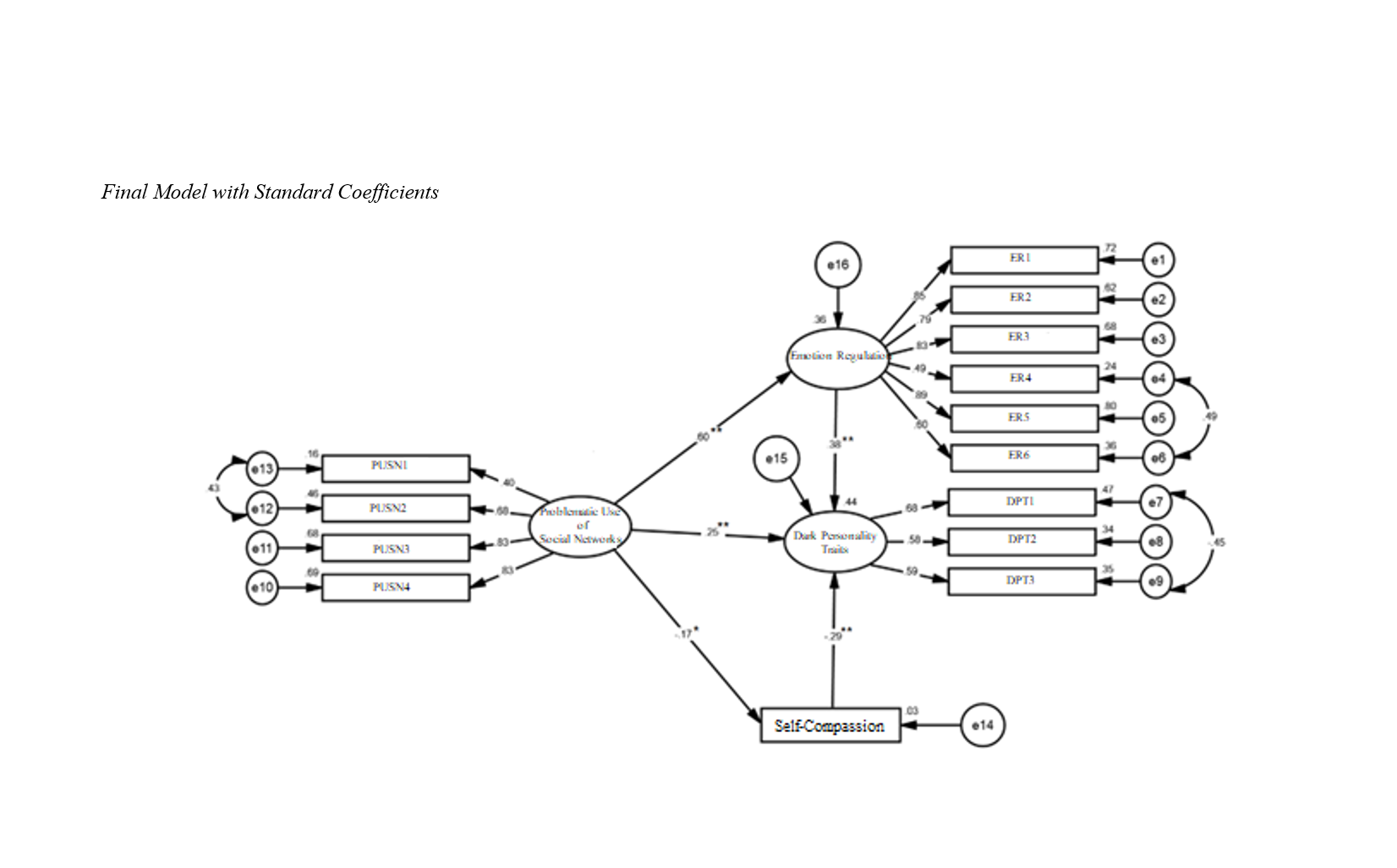
Despite the information dissemination and communication facilities provided by these networks, they have also brought about damages. The purpose of the current research is to investigate the relationship between problematic social media use and dark personality traits with the mediating role of emotion regulation and self-compassion among adult Instagram users in Tehran. The methodology of this study is descriptive-correlational, employing a structural equation modeling approach. The population of the study consisted of all adult Instagram users (ages 18 to 80) in Tehran in the year 2022. The sample size was 306 individuals, selected through convenience sampling. The questionnaires used in this research were the Mobile Social Networking Addiction Questionnaire by Khajeh Ahmad and colleagues (2016), Dark Personality Traits by Jonason and Webster (2010), Emotion Regulation by Gratz and Roemer (2004), and Self-Compassion by Neff (2003). Analysis of the findings was conducted using structural equation modeling by AMOS-22. Findings showed that problematic social media use among adult Instagram users has a positive and significant relationship with dark personality traits (P<0.01). Self-compassion also has a negative and significant relationship with dark personality traits (P<0.01). Emotion regulation was found to have a positive and significant relationship with dark personality traits (P<0.01). Therefore, it can be concluded that self-compassion and emotion regulation are two important components in predicting the problematic use of Instagram by users.
Downloads
References
1. Parsakia K, Rostami M, Saadati N, Navabinejad S. Analyzing the causes and factors of the difference between the girls of the generation Z and the previous generations in Iran from the perspective of social psychology. Psychology of Woman Journal. 2023;4(1):1-13. [DOI]
2. Mérelle SY, Kleiboer AM, Schotanus M, Cluitmans TL, Waardenburg CM, Kramer D, et al. Which health-related problems are associated with problematic video-gaming or social media use in adolescents? A large-scale cross-sectional public health study. Clinical Neuropsychiatry. 2017;14(1):11-9.
3. Horwood S, Anglim J. Emotion Regulation Difficulties, Personality, and Problematic Smartphone Use. Cyberpsychology, Behavior, and Social Networking. 2020;24(4):275-81. [PMID: 33090002] [DOI]
4. Hayixibayi A, Strodl E, Chen W, Kelly AB. Associations Between Adolescent Problematic Internet Use and Relationship Problems in Chinese Families: Findings From a Large-Scale Survey. Jmir Pediatrics and Parenting. 2022. [PMID: 36279160] [PMCID: PMC9641517] [DOI]
5. van Dijk R, van der Valk IE, Vossen HG, Branje S, Deković M. Problematic internet use in adolescents from divorced families: the role of family factors and adolescents’ self-esteem. International journal of environmental research and public health. 2021;18(7):3385. [PMID: 33805855] [PMCID: PMC8037960] [DOI]
6. Alimoradi Z, Lin C-Y, Broström A, Bülow PH, Bajalan Z, Griffiths MD, et al. Internet addiction and sleep problems: A systematic review and meta-analysis. Sleep Medicine Reviews. 2019;47:51-61. [PMID: 31336284] [DOI]
7. Mohebi M, Asadzade H, Farrokhi N. Modeling the structural relationships of internet addiction based on executive functions and problems interpersonal: the mediating role of Alexithymia. Shenakht Journal of Psychology and Psychiatry. 2020;7(3):150-65. [DOI]
8. Tang WY, Reer F, Quandt T. The interplay of gaming disorder, gaming motivations, and the dark triad. Journal of Behavioral Addictions. 2020;9(2):491-6. [PMID: 32544080] [PMCID: PMC8939412] [DOI]
9. Sadeghkhani M, Emamipour S, Mirhashemi M. The structural model of emotional divorce based on the dark triad traits of personality and conflict resolution styles with the mediation of marital dissatisfaction. Journal of Applied Family Therapy. 2023;4(2):444-71. [DOI]
10. Zeigler-Hill V, McCabe GA, Vrabel JK. The Dark Side of Humor: DSM-5 Pathological Personality Traits and Humor Styles. Europe’s Journal of Psychology. 2016;12(3):363-76. [PMID: 27547254] [PMCID: PMC4991045] [DOI]
11. Ueno Y, Shimotsukasa T, Suyama S, Oshio A. Correlations between the factors characteristic of competitive sports and the dark triad. Journal of Physical Education and Sport. 2017;17(2):533.
12. Vaughan R, Carter GL, Cockroft D, Maggiorini L. Harder, better, faster, stronger? Mental toughness, the dark triad and physical activity. Personality and Individual Differences. 2018;131:206-11. [DOI]
13. Şakiroğlu M. The effect of self control and emotion regulation difficulties on the problematic smart phone use of young people. Uluslararası Eğitim Programları ve Öğretim Çalışmaları Dergisi. 2019;9(2):301-8. [DOI]
14. Hadadian F, Tehranizadeh M, Pakdel M. The Roles of Family, Emotion Regulation Strategies, and Mental Health in the Problematic Internet Use. Journal of adolescent and youth psychological studies. 2020;1(1):317-27.
15. Sorkhabi Abdolmaleki M, Dokaneifard F, Behdodi M. Causal explanation of emotional divorce of married women: the role of cognitive emotion regulation strategies and marital burnout. Psychology of Woman Journal. 2021;2(3):14-28.
16. Ghafoori N, Haghayegh A. The relationship family functioning and social network addication with regard to the mediating role of emotional self-regulation in adolescents. Information and Communication Technology in Educational Sciences. 2021;11(3):47-64.
17. Goldsmith RE, Chesney SA, Heath NM, Barlow MR. Emotion Regulation Difficulties Mediate Associations Between Betrayal Trauma and Symptoms of Posttraumatic Stress, Depression, and Anxiety. Journal of Traumatic Stress. 2013;26(3):376-84. [PMID: 23737296] [DOI]
18. Barnow S, Aldinger M, Ulrich I, Stopsack M. Emotionsregulation bei Depression. Psychologische Rundschau. 2013;64(4):235-43. [DOI]
19. Kircaburun K, Griffiths MD. The dark side of internet: Preliminary evidence for the associations of dark personality traits with specific online activities and problematic internet use. Journal of Behavioral Addictions. 2018;7(4):993-1003. [PMID: 30427212] [PMCID: PMC6376394] [DOI]
20. Nejat A, Rafezi Z, Hossseinsabet F. Predicting Obsessive-Compulsive Disorder based on Mindfulness, Cognitive Emotion Regulation Strategies, and Coping Strategies. Journal of Research in Behavioural Sciences. 2020;18(2):249-59. [DOI]
21. Hamidikian P, Niknam M, Jahangir P. Prediction of latent marital aggression and fear of intimacy based on self-compassion with the mediating role of guilt in married people. Applied Family Therapy Journal (AFTJ). 2023;2(1):65-90. [DOI]
22. Hollis-Walker L, Colosimo K. Mindfulness, self-compassion, and happiness in non-meditators: A theoretical and empirical examination. Personality and Individual differences. 2011;50(2):222-7. [DOI]
23. Allen AB, Leary MR. Self-Compassion, Stress, and Coping. Social and Personality Psychology Compass. 2010;4(2):107-18. [PMID: 20686629] [PMCID: PMC2914331] [DOI]
24. Brophy K, Brähler E, Hinz A, Schmidt S, Körner A. The role of self-compassion in the relationship between attachment, depression, and quality of life. Journal of Affective Disorders. 2020;260:45-52. [PMID: 31493638]
25. Gerber Z, Tolmacz R, Doron Y. Self-compassion and forms of concern for others. Personality and Individual Differences. 2015;86:394-400. [DOI]
26. Neff KD. Setting the record straight about the Self-Compassion Scale. Mindfulness. 2019;10(1):200-2.
27. Wai M, Tiliopoulos N. The affective and cognitive empathic nature of the dark triad of personality. Personality and Individual Differences. 2012;52(7):794-9. [DOI]
28. Muris P, Merckelbach H, Otgaar H, Meijer E. The Malevolent Side of Human Nature: A Meta-Analysis and Critical Review of the Literature on the Dark Triad (Narcissism, Machiavellianism, and Psychopathy). Perspectives on Psychological Science. 2017;12(2):183-204. [PMID: 28346115] [DOI]
29. Cao X, Gong M, Yu L, Dai B. Exploring the mechanism of social media addiction: an empirical study from WeChat users. Internet Research. 2020;30(4):1305-28. [DOI]
30. Moretta T, Buodo G. Modeling Problematic Facebook Use: Highlighting the role of mood regulation and preference for online social interaction. Addictive Behaviors. 2018;87:214-21. [PMID: 30056306] [DOI]
31. Kline RB. Principles and practice of structural equation modeling: Guilford publications; 2023.
32. Mehboodi K, Mohammadi N, Rahimi C, Sarafraz MR. The efficacy of intensive short-term dynamic psychotherapy (ISTDP) on self-esteem, emotion regulation, and defense mechanisms in men with social anxiety disorder. Journal of Psychological Science. 2022;21(111):461-74. [DOI]
33. Özer E. Five Factor Personality Traits in Self-Compassion, Coping Strategies and Communication Skills. Turkish Psychological Counseling and Guidance Journal. 2022;12(64):131-53. [DOI]
34. Wang X, Chen Z, Poon K-T, Teng F, Jin S. Self-compassion decreases acceptance of own immoral behaviors. Personality and Individual Differences. 2017;106:329-33. [DOI]
35. Sirois FM, Kitner R, Hirsch JK. Self-compassion, affect, and health-promoting behaviors. Health Psychology. 2015;34(6):661-9. [PMID: 25243717] [DOI]
36. Movahedrad F, Seyed Alitabar SH, Mohammadi A, Hoseinifard V. The effectiveness of strength-based counseling on the tendency toward marital infidelity and self-compassion of conflicted couples. Journal of Assessment and Research in Applied Counseling. 2023;5(2):8-14. [DOI]
37. Hosseini S, Salehi M, Jadidi M, Aghili M. The Mediating Role of cognitive Emotion Regulation Explaining the Casual Relationship between Personality Traits and Fear of Cancer Recurrence in Breast Cancer Survivors. Iranian Journal of Breast Diseases. 2023;16(2):4-21. [DOI] [DOI]
38. Zysberg L, Raz S. Emotional intelligence and emotion regulation in self-induced emotional states: Physiological evidence. Personality and Individual Differences. 2019;139:202-7. [DOI]
39. Koladich SJ, Atkinson BE. The dark triad and relationship preferences: A replication and extension. Personality and Individual Differences. 2016;94:253-5. [DOI]
40. Predicting internet addiction with the dark triad: Beyond the five-factor model [press release]. US: Educational Publishing Foundation2021.
41. Ho SS, Lwin MO, Lee EWJ. Till logout do us part? Comparison of factors predicting excessive social network sites use and addiction between Singaporean adolescents and adults. Computers in Human Behavior. 2017;75:632-42. [DOI]
42. Brand M, Wegmann E, Stark R, Müller A, Wölfling K, Robbins TW, et al. The Interaction of Person-Affect-Cognition-Execution (I-PACE) model for addictive behaviors: Update, generalization to addictive behaviors beyond internet-use disorders, and specification of the process character of addictive behaviors. Neuroscience & Biobehavioral Reviews. 2019;104:1-10. [PMID: 31247240] [DOI]
Downloads
Additional Files
Publication Timeline
License
Copyright (c) 2024 Sara Jamshidi (Author); Azam Noferesti (Corresponding Author); Hojjatollah Farahani (Author)

This work is licensed under a Creative Commons Attribution-NonCommercial 4.0 International License.