Comparing the Effectiveness of Solution-Focused Therapy and Dialectical Behavior Therapy on Self-Care and Quality of Life in Patients with Type 2 Diabetes
DOI:
https://doi.org/10.61838/kman.hn.2.2.10Keywords:
Self-care, Dialectical behavior therapy, Solution-focused therapy, Quality of lifeAbstract
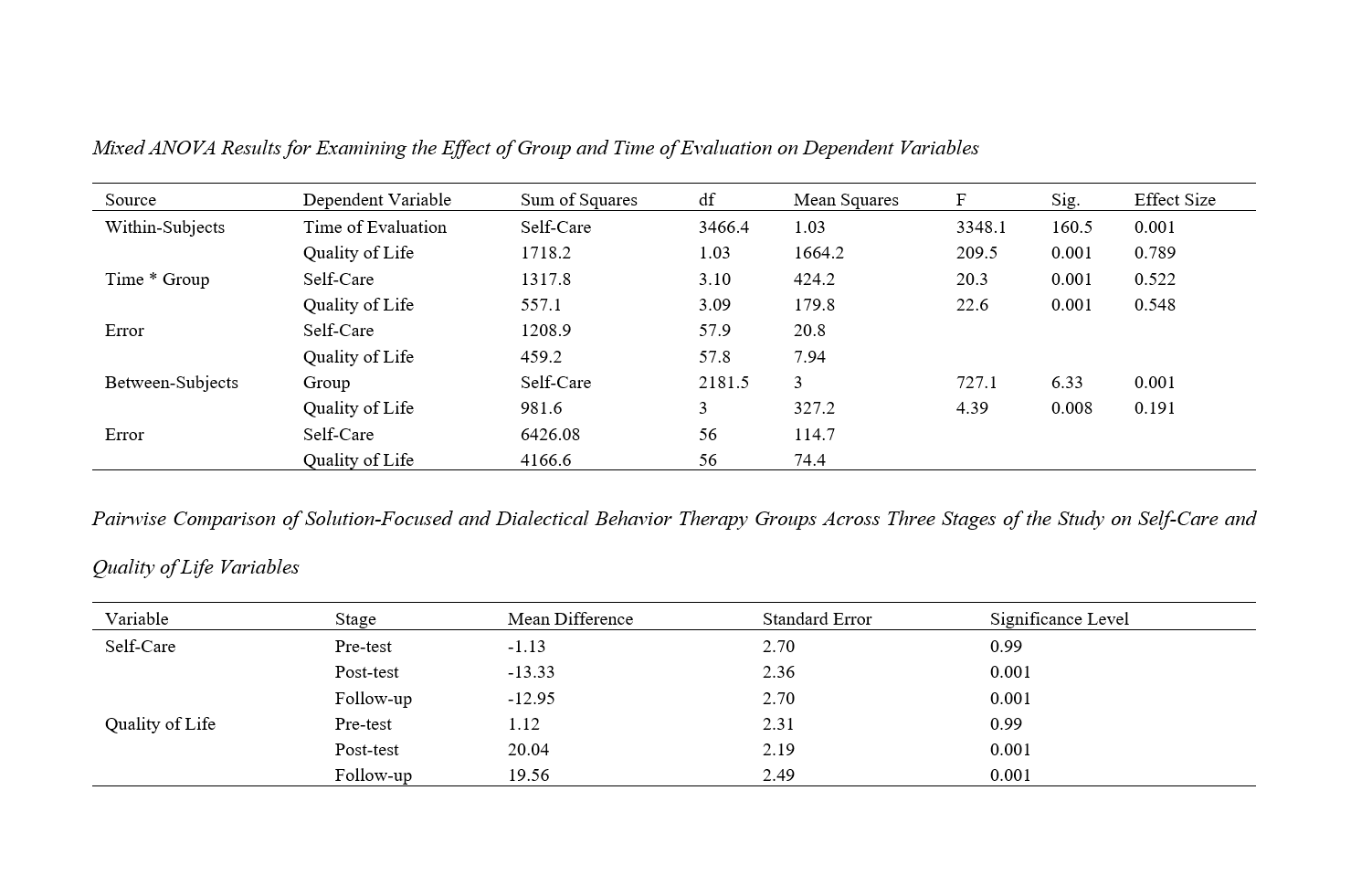
The objective of this study was to compare the effectiveness of solution-focused therapy and dialectical behavior therapy on self-care and quality of life in patients with type 2 diabetes. The present research was a semi-experimental pre-test, post-test with control group design including a follow-up period. The study population consisted of women with diabetes attending a health care center in District 6 of Tehran, of whom 45 were purposively selected and randomly assigned to two experimental groups (solution-focused therapy and dialectical behavior therapy) and one control group. The Self-Care Self-Efficacy Questionnaire by Lu (1996) and the WHOQOL BREF quality of life questionnaire were used. The first experimental group underwent seven 90-minute sessions of solution-focused therapy, and the second experimental group underwent eight 90-minute sessions of dialectical behavior therapy. Repeated measures analysis of variance was used for data analysis. Findings indicated that both solution-focused therapy and dialectical behavior therapy significantly improve self-care and quality of life (p < 0.05). Additionally, results showed that dialectical behavior therapy was more effective than solution-focused therapy in improving self-care and quality of life (p < 0.05). In conclusion, both solution-focused therapy and dialectical behavior therapy are effective in improving self-care and quality of life in patients with type 2 diabetes, with dialectical behavior therapy being more effective. Therefore, these approaches can be utilized alongside medical interventions in clinical settings.
Downloads
References
1. Sun H, Saeedi P, Karuranga S, Pinkepank M, Ogurtsova K, Duncan BB, et al. IDF Diabetes Atlas: Global, regional and country-level diabetes prevalence estimates for 2021 and projections for 2045. Diabetes Research and Clinical Practice. 2022;183. [PMID: 34879977] [DOI]
2. Zhang J, Deng Y, Wan Y, Wang J, Xu J. Diabetes duration and types of diabetes treatment in data-driven clusters of patients with diabetes. Frontiers in Endocrinology. 2022;13. [PMID: 36457559] [PMCID: PMC9705576] [DOI]
3. ElSayed NA, Aleppo G, Aroda VR, Bannuru RR, Brown FM, Bruemmer D, et al. 3. Prevention or Delay of Diabetes and Associated Comorbidities: Standards of Care in Diabetes—2023. Diabetes Care. 2022;46(Supplement_1):S41-S8. [PMID: 36507633] [PMCID: PMC9810464] [DOI]
4. Ahmad F, Joshi SH. Self-Care Practices and Their Role in the Control of Diabetes: A Narrative Review. Cureus. 2023;15(7). [DOI]
5. Brown Sue A. On the Path toward Expanding Treatment Options for Diabetes. New England Journal of Medicine. 2022;387(10):935-6. [PMID: 36069876] [DOI]
6. Bijani M, Jafarnejad A, Bazrafshan MR, Atef S, Sarvestani PS, Dehghan A. Comparison the health related quality of life in type 2 diabetic patients and healthy people: A Cross-Sectional Study in Iran. Clinical Diabetology. 2021;10(4):370-4.
7. Mohammadi S, Karim NA, Talib RA, Amani R. Evaluation of quality of life among type 2 diabetes patients. International Journal Of Community Medicine And Public Health. 2017;3(1):51-6. [DOI]
8. Hemmati Maslakpak M, Alipor S, Aghakhani N, Khalkhali H. The effect of family-centered care on adherence to treatment in patients with type 2 diabetes. Yektaweb. 2020;27(2):1686-941.
9. Montazernia B, Koushki S, Oraki M, Mirzaian B. Comparing The Efficacy of Acceptance and Commitment Therapy (ACT) and Dialectical Behavior Therapy Skills Training (DBT-ST) on Cognitive Emotion Regulation in Patients with Type II Diabetes. Iranian Journal of Health Psychology; Vol. 2021;4(1).
10. Azizi A, Ghasemi S. Comparison the Effectiveness of Solution-Focused Therapy, Cognitive-Behavior Therapy and Acceptance and Commitment Therapy on Depression and Quality of Life in Divorced Women. Counseling Culture and Psycotherapy. 2017;8(29):207-36.
11. Salimi H, Sodani M. The Effectiveness of Solution-Focused Brief Couple Therapy on Increasing Couples’ Marital Self-Regulation and Emotional Distress Tolerance. Research in Clinical Psychology and Counseling. 2023;13(1):5-24.
12. Lu H, Liu H, Zhang J, Wu J, Wu F, Lu D. Application of Dialectical Thinking in Clinical Teaching of Type 2 Diabetes. Frontiers in Medical Science Research. 2019;1(4).
13. Pahlavan F, Ramezani K, Rasouli Y. The Effectiveness of “Dialectical Behavior Therapy” on Basic Psychological Needs and Health Hardiness in Patients with Type 2 Diabetic. Journal of Health Promotion Management. 2022;11(5):66-79.
14. Shandiz FK, Shahabizadeh F, Ahi Q, Mojahedi M. The Effectiveness of Dialectical Behavioral Therapy on Stress and Cognitive Flexibility in Women With Type 2 Diabetes. 2021.
15. Sheikh S, Alzackerini SM, Shirmahaleh FM, Zam F, Baseri A. Investigating the effect of two methods of dialectic behavioral therapies and metacognitive therapy on the body mass index and emotional eating behavior in patients with type 2 diabetes. International Journal of Health Studies. 2021:36-42.
16. Rafie Z, Vakilian K, Zamanian M, Eghbali H. The effect of solution-oriented counseling on coping strategies in mental health issues in women with gestational diabetes. Administration and Policy in Mental Health and Mental Health Services Research. 2021;48(6):983-91. [PMID: 33559816] [DOI]
Downloads
Additional Files
Publication Timeline
License
Copyright (c) 2024 Zahra Lotfi, Mehrnoosh Sheikhi, Mahta Damavandi, Fatemeh Mirzaei (Author); Negin Towsyfyan (Corresponding Author)

This work is licensed under a Creative Commons Attribution-NonCommercial 4.0 International License.